
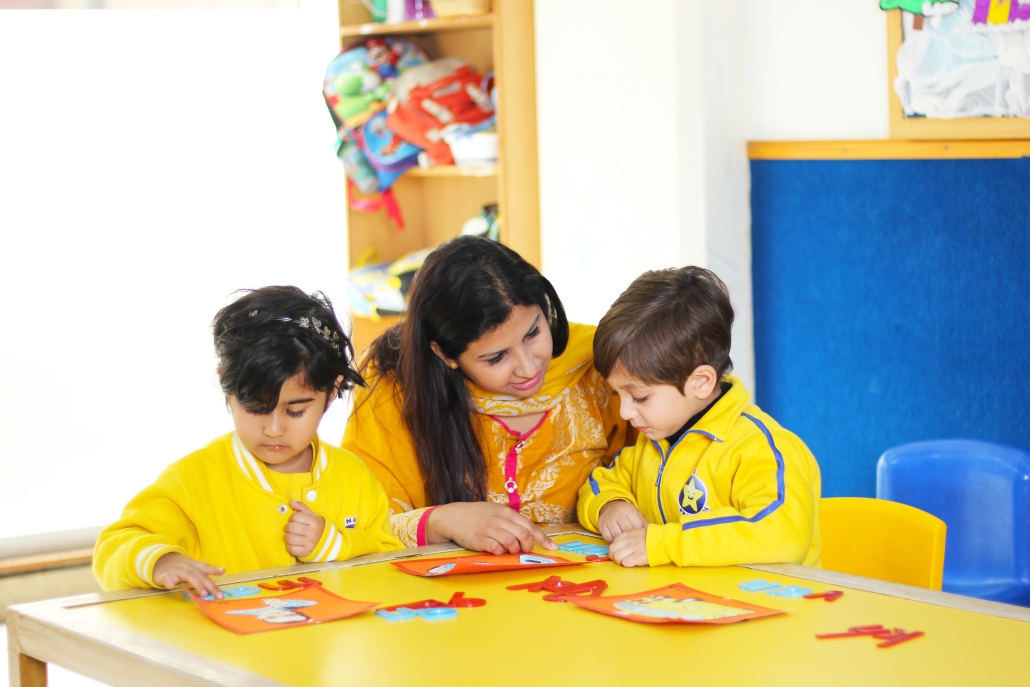
PLAYGROUP, NURSERY AND MONTESSORI IN PAKISTAN
‘In which school should I admit my 3 – year old ?’
In Pakistan, this is most significant question in the mind of every first-time parent. Parents are flooded with a vast number of choices. School advertisements, social media and acquaintances give multiple options and every other person shares his personal experiences. The voices they hear are mostly like,
- ‘Admit in Montessori School!’
- ‘Do not send your child to playgroup. It is waste of time and money!’
- ‘Start school from Nursery!’
- ‘The child will be left behind if he skips playgroup!’
Thus, the need to explain the difference between Playgroup, Nursery and Montessori becomes crucial. In Pakistan, Playgroup, Nursery, Kindergarten and Montessori are usually regarded as synonymous.
However, the philosophy and methodology of all four is different. Playgroup, Nursery and Kindergarten, all three blend Early Childhood Education Methods for teacher-led learning and development through activity – based group activities and pre- academics. Whereas, Montessori System of Learning, as developed by Dr. Maria Montessori is a child- led, self-paced learning. Its primary emphasis is on developing practical life skills and sensory exploration using specialized materials.
Comparative Summary
| Age Range | Learning
Focus |
Learning Style
Role of Teacher |
Goal | |
| Playgroup | 2 – 3 | Social skills
Physical Skills Daily Routine |
Teacher – led Play / Activity Based
Learning through arts Rhymes and Storytelling |
Smooth transition from home to school |
| Nursery | 3 – 4 | Alphabets
Numbers Reading Writing |
Teacher directed activities
Whole class schedule All do the same task at the same time |
Prepare for formal learning |
| Montessori | 3 – 6 | Practical life skills
Sensory awareness Independence |
Self – directed
No traditional classroom set-up Special Montessori materials are used for teaching life skills Children are free to choose their activities Younger children learn from older children |
Develop focus and concentration
Motivation Hands’-on practical life skills Conceptual understanding |
| Kindergarten | 4 – 5 | Focus on academics
Math English , Urdu General Knowledge |
Teacher controlled activities
Stress on developing reading and writing skills Whole class written work and instructions |
Academic and behavioural readiness for Grade One |
Key Features:
In Pakistan, as most early years schools are similar except in name only, therefore, it is necessary to understand their key features, which are as follows:
- Playgroup:
- Age of admission – Older than two or two and a half.
- It is a child’s first experience away from home
- A playgroup is a soft and gentle introduction to preschool.
- So, most preschools focus on developing the child’s confidence and providing a safe environment.
- Learning is provided through fun- based playful activities
- Social skills such as sharing and caring are developed
- Rhymes, stories and games are utilized under the active guidance of the teacher.
- Formal academic work is less
- Nursery
- Nursery or Reception is the second logical step after playgroup.
- Children are introduced to basic academics of reading, writing and arithmetic.
- Focus is on developing language and literacy skills.
- Oracy is developed through listening and speaking activities
- Reading is developed through alphabets and phonics
- For developing writing skills, children are introduced to pre-writing skills.
- Number concepts are developed through numeracy
- Children are taught about the world around them through basic concepts of shapes, colours
- Children follow a structured routine and time-table.
- Focus is on building a disciplined learning schedule and style
- They have to follow the teacher’s instructions
- Students are introduced to formal schooling
- Montessori
- Montessori is neither a grade nor a level.
- It is a method of teaching young children and was developed by Dr. Maria Montessori.
- According to this method children are directed to discover and learn on their own.
- In Montessori System, every child learns at own pace.
- There is no stress on children or competition with others.
- Specialized materials were designed by Dr. Montessori for teaching various concepts.
- A Montessori classroom has children of different ages from 3 – 9
- Younger children interact and learn from older children like siblings.
- Focus is on use of hands-on activities (learning by doing) for the development of:
- Self learning and independence.
- Early Practical Life Skills (EPL)
- Like pouring, organizing and cleaning
- Independence and self-discovery
- Focus and concentration
- Creativity and problem – solving
- Sensory Learning through the use of five senses
- Teachers act as guides rather than traditional instructors.
Practical Advice for Parents in Pakistan
- Check the Vocabulary:
In Pakistan, there are only a handful of true Montessori Schools. Most schools label themselves as “Montessori” for marketing purposes. Do check before enrolling your child if the school follows the proper Montessori System of Teaching – Learning. Personally visit the schools and the classrooms to ensure Montessori Equipment and methodology is being utilized.
- Montessori vs. playgroup – In Pakistan, the purpose of both is to provide Early Childhood Education but the major difference lies in the way learning is delivered, the role of the teacher and the classroom environment.
- Playgroup – Best for 2 – 3-year-olds as it leads to social and emotional development as well as physical development.
- Nursery: Best for 3 + to 4 year olds as it provides more opportunities of cognitive development
- Montessori: It can be an ideal choice for your child if the school follows the true Montessori methodology and the teachers are trained in conducting it, as it develops independence and self-confidence.
When choosing a preschool in Pakistan, pay more attention to the quality of teachers, safety, cleanliness, child-teacher ratio, and learning environment than to the label “Playgroup,” “Nursery,” or “Montessori.”
Choosing the right preschool can feel confusing, but once you understand the purpose of each, it becomes much more easier.
Remember:
- If your 4 – year child likes to follow a pattern and guidance then choose Nursery.
- If your child likes to explore on his own and has an independent will then select Montessori.
- If your child is younger than 4, admit in Playgroup
Conclusion
Observe and check the following when you visit a school:
- Teachers – Behaviour and demeanour towards children. Are they instructing or guiding, commanding or helping
- Classroom Environment – is it rigid or flexible. Do children sit in set seats or are they allowed to move around the room, change places or even change the seating arrangement.
- Happiness and Engagement – Are the children sitting idle and bored or quiet and disciplined or are they happily and excitedly busy in multiple activities.
Finally, a child’s happiness and pleasant attitude of a teacher is much more important than the name or brand of a school.